Showing posts with label art. Show all posts

Thursday, April 21, 2011

Buying Art (for cheap) is Fun

I recently attended a silent auction, the modest proceeds of which went to the IFRC. The things being auctioned were artworks, mostly on paper. I got three, about which more in a future post after I photograph them. But I will at least give a sort of preview: Two by Ryuta Suzuki and one by Kati Verebics.

It’s a safe bet that I got all three well under market value. I almost got into a little bidding war with someone, but he mysteriously declined to bid on the things I wanted, perhaps intimidated by my hovering around waiting to double down. And I had passer’s remorse about not having bid on something, until I found out the winning bid belonged to a very nice guy.

I don’t often buy art. Very rarely in fact. And not because it’s expensive; while it can be very costly there’s always something you can afford, however minor. The thing is, if you’re collecting art you have to put it somewhere, and you feel sort of bad if that somewhere isn’t a wall.

I suppose you know you’re actually collecting art when you no longer feel bad about not displaying it. I could imagine getting to that point, or if you like falling into that trap, but not soon. I’ve got a sweet little apartment with more windows than walls, and a lot of geographic instability in the mix, and I’m not yet ready to invest in another flat file. Not quite yet.

It’s probably not an easy thing putting together a charity auction. This one had some local artists I’d heard of (including a few I know personally); and some I hadn’t heard of; and some strangers from far afield, whose contributions were sometimes relevant and sometimes not. The quality was very uneven, but in Budapest the quality of a museum show can be just as uneven (I’m lookin’ at you, MüPa!).

Some good things about the auction: admirable transparency about the finances; no hidden reserves; good art on the cheap for a good cause.

Some less-good things: no alcohol (what were they thinking?); a rather, shall we say, distant house staff; no real PR about the artists or works (remember, most people at a charity auction know nothing about art); and, sadly, not enough people wanting to spend money.

As one of the modestly solvent people in the room, I definitely would have spent more on the works I bought if there had been enemy bids. I wouldn’t have gone to the moon, but I definitely would have gone to double what I spent. In one case I almost felt like bidding against myself but part of the adrenalin kick of an auction, even a noncompetitive one, is the tension between wanting what you want, and wanting to get it at the lowest price going.

I know these things are easier said than done, but it seems to me that there are some obvious steps to help raise more money at a charity auction. So I shall play Lucy for a moment and offer...

Cheap Advice for Silent Charity Auctions

  1. Work your connections and get every well-off person you know to attend.
  2. “Well-off” means “able to place the lowest available minimum bid without pain.”
  3. Have plentiful, non-shitty free booze. Get it sponsored of course.
  4. Have a friendly, attractive staff serving the plentiful free booze.
  5. Flatter people unnecessarily.
  6. Make it easy to bid competitively and anonymously.
  7. Have professional promotional materials on hand about your cause, your beneficiary, and every artist.
  8. Include take-home materials, e.g. a high-production-value flyer.
  9. If you don’t know how to do that yourself, get somebody who does know to do it for free for the good cause.
  10. Apply the rule above to every aspect of the auction. You’re already a hero for organizing it in the first place.

In short, it was fun, I totally scored, and I think I’ll try this sort of thing again. But first I have to find a good framer.

A Parting Thought On the Arts and the Web

Why is it that artists and cultural institutions, much like restaurants, generally have not heard the news that Flash-only websites are broken and reflect badly on their owners?

In the case of individual artists, I’m inclined to think of it as similar to the restaurant problem. Creative people get talked into some gimmicky animation and don’t know any better, so up it goes. But when a well-funded Palace of the Arts hires some clueless two-bit company to rain misery on its potential ticket buyers, then I have no choice but to smell a rat.

An example of the first: Mr. Suzuki’s portfolio. Of the second: MuPa.hu, a study in inaccessibility.

Friday, December 18, 2009

Robert Hughes: Charismatic, fun, sloppy - and out of touch?

I was recently pointed to Robert Hughes' Mona Lisa Curse, which is available in 12 parts on YouTube. It's a documentary about the influence of the modern market on the art world. It's also something of a polemic against that influence.

Hughes sees the Mona Lisa's American tour in the 1960's as the starting point, or at least the symbolic kickoff, of an historic realignment of art collecting. Art has come to be seen by its collectors primarily as an investment, and that activity has both priced art museums out of the market and had undue influence on the public perception of relative artistic quality.

Unfortunately, for all his gruff style and contrarian hipness even at 70, Hughes only makes half an argument.

The high prices of blue-chip contemporary art today undoubtably make high-stakes collecting a game for the rich. And it certainly is beautiful to think of a postal clerk and a librarian amassing a major collection, which was once possible and now apparently not.

At least it's not possible if you look to the activities of the rich as your arbiter of artistic quality, which Hughes of course suggests we should not. But at the same time an enormous number of people are making contemporary art, and most of them sell, if they sell at all, at prices quite compatible with a modest income dedicated to collecting.

The same argument can be made for museums: if the rich collectors are skewing the meritocracy of art, why should the museums buy what they collect? And they are not then where exactly is the problem?

Hughes doesn't tell us how this world of the rich setting the public art agenda is any different than it always was. I would argue that it's more democratic by far, even if it's more crass: a Farnese wielded far more power over the art world than a Cohen ever will.

But Hughes argues that the Cohens are lacking taste, whereas the Farnese had it. This may be true, though it could also have to do with the fact that contemporary artists are fairly autonomous and don't do their best work on commission, whereas the Pope could once upon a time tell a Tiziano to paint and the painter would give it his all.

The Mona Lisa Curse also has nothing to say about the personal enrichment of the artists themselves. Much is made of the feelings of betrayal in the early days of aggressive dealership in the US, but that was long ago. Bob Rauschenberg was already a very wealthy man by the time I first saw his work. There is a scene in which Rauschenberg confronts Mr. Scull, who has just made a tremendous profit on work by Rauschenberg and Johns. The dealer tells him, in effect, that he's just made him permanently rich, since his prices will now be much higher.

Scull is right. Rauschenberg is an ingrate. At the moment it probably seemed like precisely the opposite was true, but watching the scene in 2009 it's glaringly apparent how symbiotic that relationship was. Hughes seems to wish it weren't.

And what about the artists?

Hughes spends a fair amount of energy airing his contempt for Andy Warhol, both the man and his work. While quoting him on the Mona Lisa tour, Hughes also calls him stupid. And when discussing a collector who owned 800 Warhols, Hughes is clearly disgusted by the very concept. You can't miss the point of Warhol by a wider margin than that.

Some of the anti-Warhol tirade may also be personal. Considering how central Rauschenberg is to the Hughes canon, and considering how famously Rauschenberg disliked Warhol and his queeny tribe, there is a whif of argumentum ad hominem about the whole thing.

Another artist who takes a beating in the documentary is Damien Hirst. But here it's more deserved: the shark really hasn't aged well, neither physically nor conceptually. And the big visible woman scultpure is truly, breathtakingly awful; freshman work with an industrial budget.

However, I remember being quite inspired by some of Hirst's work when I was studying. Particularly One Thousand Years is still a strong idea. And of course For the Love of God is held up as the ultimate example of the depraved art market, but - Earth to Critic! - it's a work specifically about the depravity of the art market. He might as well have titled it For the Love of Bob.

There are plenty of other artists who have made a lot of money from the modern collecting machine. Would the world somehow be better if they hadn't? Would their art be more pure? Maybe - maybe Brice Marden would make a new picture instead of painting the same old one over and over again. But shouldn't the artists have something to say about that?

And as for the museums being priced out of the game, I see no reason why that matters or is particularly new. Collectors are not the only people who can donate artwork: if major artists don't themselves keep major works for public collections, that's hardly the art market's fault.

Finally there is a segment in which Hughes bullies a rich but clueless collector. This comes across as an utterly unfair fight. And I think Hughes enjoys it precisely because it's unfair, which is sad. The collector has already been shown earlier in the show to be no great thinker on art.

It could have been left at that, but Hughes corners him and effectively requires him to prove that he isn't very bright but thinks his possessions matter anyway. Congratulations. Having now proved, against all odds, that dumb people can also inherit great wealth, which universal conundrum shall the Critic tackle next?

So what is it that Hughes wants artists, collectors and museums to do?

As far as I can tell he wants artists to use their own hands to make works that have to do with contemporary society, as long as it's still recognizably "art."

Collectors ought perhaps to spend less and be less competitive. Less, you know, >new money.< Right, I'll get back to you on that, or my people will.

Museums should be less commercial, less sponsored, less in thrall to their donors and less crowded. I suppose the Getty has achieved that, by having the One Greater Donor and being hard to reach. I'll take crowded, exciting, whorish and available any day. And a knock-off Murakami bag from China.

Hughes is a tough and charismatic contrarian. I highly recommend the documentary. But I can't help thinking he's out of touch.

Sunday, July 13, 2008

Omega Recoil at the Fire Arts Festival

Tonight I went over to West Oakland to see the Fire Arts Festival, and particularly to see Omega Recoil's "Rat Scientists" performance.

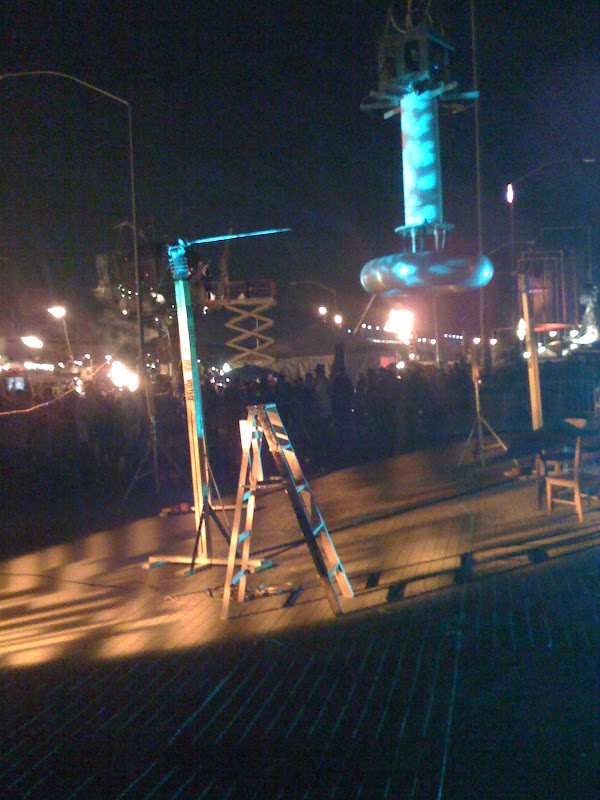
IMG_0557.JPG

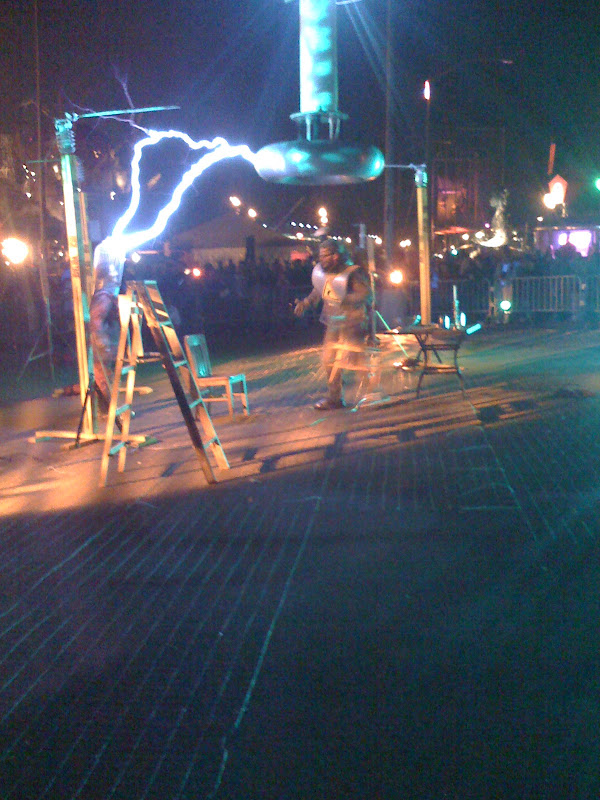
It's a really fun bit of absurdist theater, in which giant rats in lab coats conduct experiments on "human" subjects beneath a giant upside-down Tesla coil. That's right, monkey boy: beneath an upside-down Tesla coil!

Beyond that, the amazing thing about the festival is all the fire. Fire looks really good. Really big flames look really good. But I actually didn't see much of anything that I'd call "fire art." Not because the art itself is the typical aesthetically immature Burning-Man-Outsider-Art sort of thing - of course it's that, and more power to it.

The reason is that it's "art with fire" instead of "fire art."

Ooh, what about a giant metal tricycle... WITH FIRE?

How about large-breasted women standing in front of.... FIRE?

Or maybe a big meditating Buddha made out of scrap metal.... WITH FIRE?

Or how about some flying trapeze artists, risking life and limb on a giant scaffolding... WITH FIRE?

To be fair, I did see a couple things that seemed to deserve the name Fire Art. There was one thing that seemed to be just a metal bucket with a flame in it. Assuming it didn't later turn into a whirlygig machine-art dingleberry WITH FIRE, then it's probably in the clear. And there was a guy who had a square column about a meter high, on a pedestal, with a fire in it, melting something on the outside. That probably qualifies too.

In that sense, the Omega Recoil show really stood out. It was fun, it wasn't self-important, it was frankly a whole lot more death-defying than any of the fire games, and it was actually about Electricity and the Tesla coil. (Presumably as a condition of participation, some wooden chairs caught fire while the hu-man subjects were basking in their electroshock mating ritual.)

(Disclosure: I live with John Behrens and Fearghal O'Dea, so I probably would have said something nice about the Rat Scientists even if I didn't like the show.)

IMG_0545.JPG

The coil at rest.

IMG_0535.JPG

Art With Fire.

Wednesday, June 06, 2007

VernissageTV Art Video Blog

I just found a cool new art blog called VernissageTV. "Verissage" means "art opening" and that's largely what the blog is about. Or should I say vlog? No, I don't like saying vlog, it sounds dumb. VernissageTV, as its name implies, has a lot of video content available for free download. Beyond that, they also have your standard link-to-stuff blogging (you're soaking in it!) and a PDF virtual magazine, which is mostly pictures and hard to manage at a whopping 10MB for one issue. They're based out of Basel, the Swiss center of art and pharmaceuticals, but almost all the content is in English. Some of the stuff is obviously only of interest to us art geeks, but they also have virtual tours of major shows you might not otherwise get to see, as well as some pretty fascinating interviews. What they don't have much of is server capacity. Downloading the videos was sloooow. And the funny thing is that they're also selling the content on DVD, presumably in high quality. Note to VernissageTV: that's what YouTube is for. Put the low-quality version there and let Google worry about the bandwidth, then sell the high quality version (ideally on the iTunes store, but that's another topic). Likewise, their hosted PDFs feature gargantuan images poorly compressed. I get the general impression they aren't very tech-savvy, and I hope that situation improves. One of their people has a Flickr page that's much, much easier to play with than the PDFs, so you should start there if you want more "illustration" than the blog provides. I've tossed this one into my "ART" bookmarks folder, and I recommend a visit. Just don't go on dial-up.